
Introduction: Out-of-pocket expenditure (OOPE) imposes substantial financial burden on households, and despite various maternal and child health (MCH) schemes, OOPE for maternal care remains high in Chhattisgarh. This study aimed to determine the extent of OOPE during the antenatal and postnatal periods among women attending a tertiary care hospital and to identify the socio-demographic and economic factors associated with OOPE. Methods: A hospital-based cross-sectional study was conducted among 220 women (110 antenatal and 110 postnatal) attending a tertiary care hospital between May and October 2025, using convenience sampling. OOPE over the preceding 30 days, and its source of financing was recorded and analysed using appropriate statistical tests. Results: Almost all participants (217 of 220) incurred some OOPE, irrespective of MCH scheme utilization. Savings were the predominant source of financing among utilizers, while borrowing was more common among non-utilizers. Direct costs, particularly transportation and food, formed a major share of postnatal expenditure. Catastrophic OOPE was significantly higher among non-utilizers (OR= 12.67, 95%CI: 5.08, 31.58) and was significantly associated with maternal age above 30 years, nuclear family type and unskilled occupation. Conclusions: Socio-demographic factors are associated with OOPE during maternal care. MCH scheme utilization was associated with lower catastrophic expenditure, but financial protection remains incomplete, particularly during Postnatal period, and gaps in awareness and access persist. Strengthening entitlement-based schemes may help progress towards universal health coverage.

Out-Of-Pocket Expenditure and its Associated Factors among Antenatal and Postnatal Women Attending a Tertiary Care Hospital in Chhattisgarh, India: A Cross-Sectional Study
 , Yogachithan Vijayakumar2 , Paul Vinoth Kumar S3
Abstract
Introduction
Universal health coverage means that all people have access to the full range of quality health services they need, when and where they need them, without financial hardship.[1]
Out-of-pocket payments for health push a substantial proportion of the global population into extreme poverty each year, and preventable maternal deaths continue to occur at unacceptably high rates worldwide.[2]
According to the National Family Health Survey-5 (NFHS-5), the average out-of-pocket expenditure per delivery in a public health facility decreased nationally as compared with the previous survey round; however, in Chhattisgarh the average OOPE increased over the same period, indicating a divergent local trend. The subsequently released NFHS-6 (2023–24) reports further national gains in institutional deliveries (90.6%), antenatal care coverage (95.9%) and health insurance coverage (60.2%);[3] however, a Chhattisgarh-specific, cost-disaggregated OOPE estimate comparable to the NFHS-4/NFHS-5 comparison has not yet been published, so the state-level financial-burden trend described above remains the most recent available specific evidence.
MCH schemes includes Pradhan Mantri Matru Vandana Yojana, Pradhan Mantri Surakshit Matritva Abhiyan, Integrated Child Development Services, Janani Suraksha Yojana and Janani Shishu Suraksha Karyakram- These five schemes address different but complementary components of maternity-related financial hardship. PMMVY and JSY primarily provide financial transfers, whereas PMSMA focuses on free antenatal care, ICDS addresses nutritional and preventive needs, and JSSK seeks to eliminate user charges and other specified expenses associated with maternity and new-born healthcare. Collectively, these programmes can reduce OOPE through three principal pathways: Direct financial support, Subsidisation or free provision of services, Prevention and early management of complications.[4]
OOPE for maternal healthcare comprises direct medical expenditure and indirect medical expenditure.[5] Most published Indian studies, including national surveys, have quantified OOPE largely for the institutional delivery event alone;[6] this may underestimate the total financial burden of maternal care, since substantial direct and indirect medical costs are also incurred during antenatal follow-up visits and postnatal care. Under-utilization of MCH services remains an important contributor to maternal mortality, with cost cited as a key deterrent.[7]
No locally generated data from Chhattisgarh have jointly examined OOPE across both the antenatal and postnatal periods, its distribution across direct medical and non-medical cost components, and its association with utilization of government MCH schemes; this represents the specific knowledge gap addressed by the present study, which sought to generate locally relevant evidence to inform recommendations for strengthening financial protection. The specific objectives were to determine the OOPE incurred by beneficiaries during the antenatal and postnatal periods, and to find out the association of catastrophic out-of-pocket expenditure with selected socio-demographic characteristics and utilization of maternal-health schemes.
Methods
Results
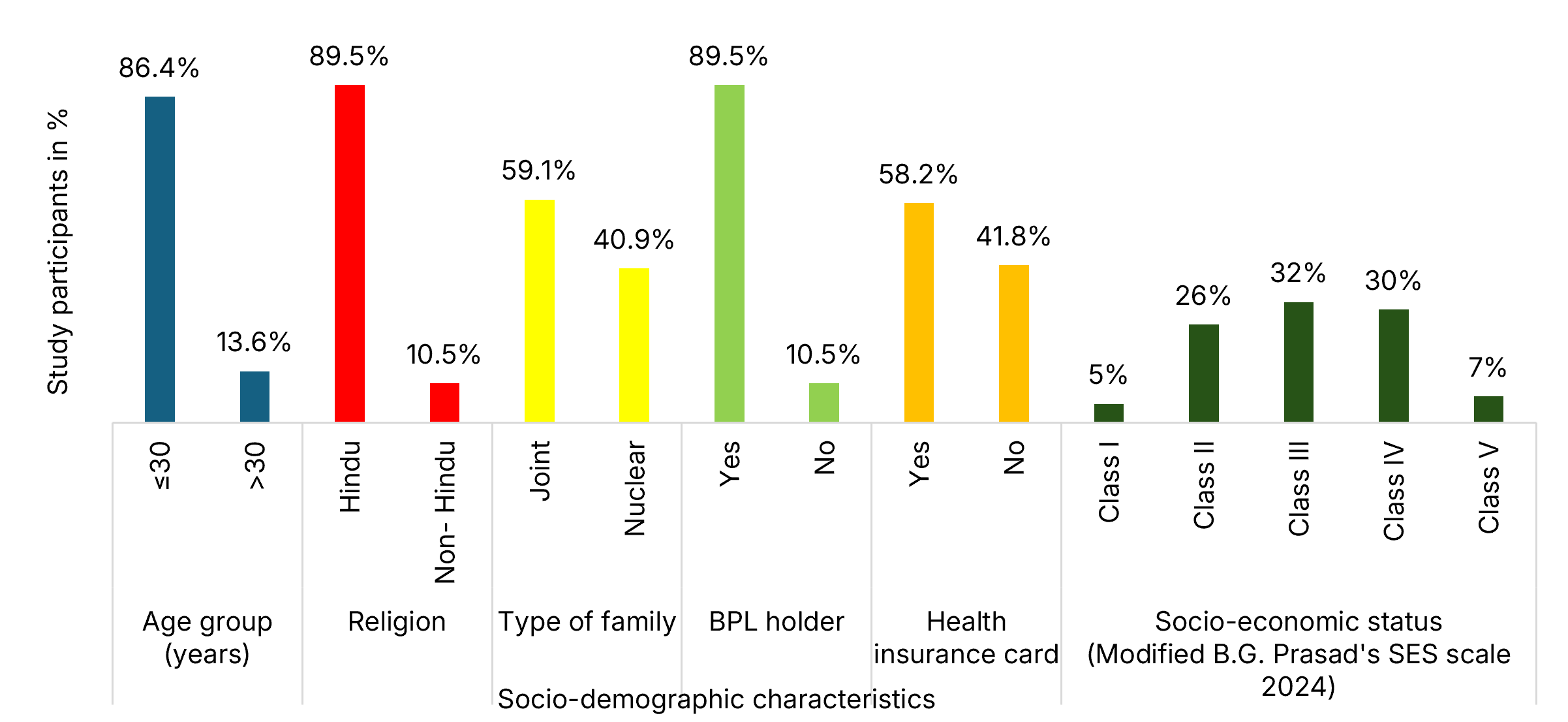
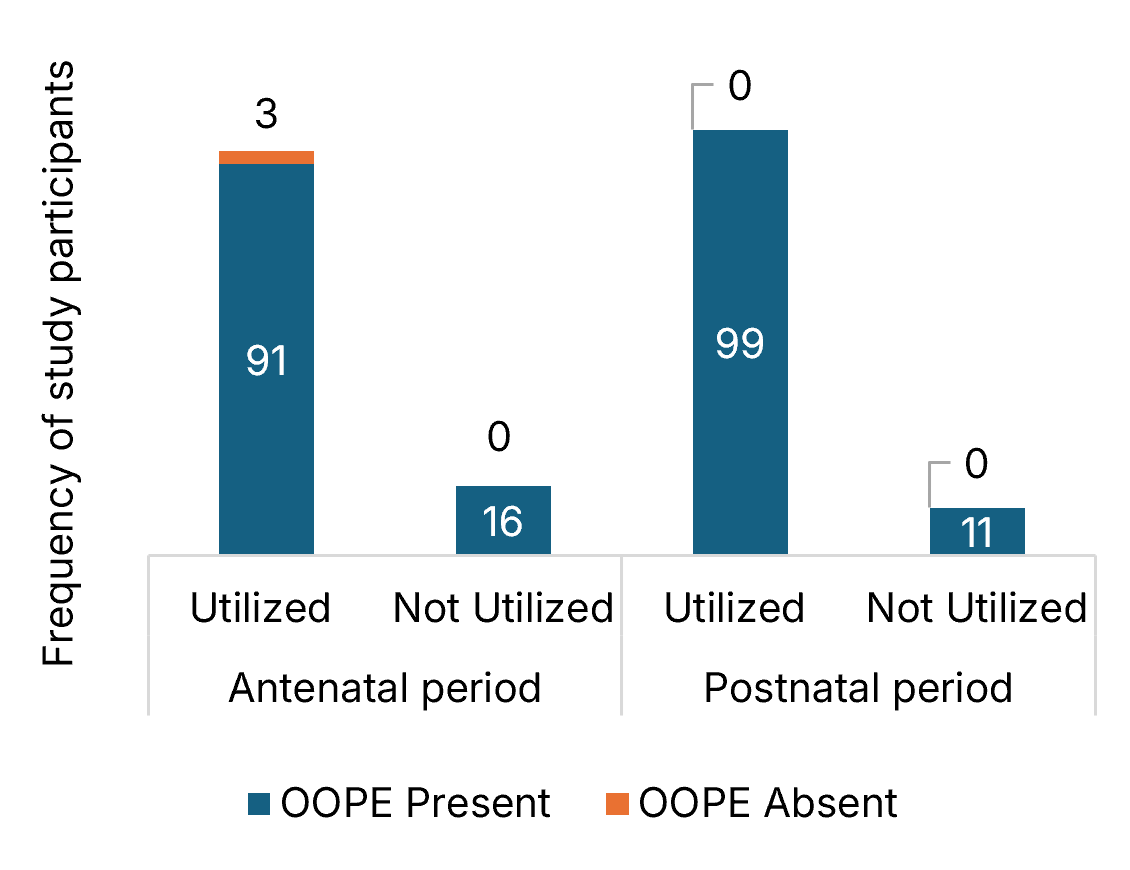
Source of income | During Antenatal Period (N=107) | During Postnatal Period (N=110) | ||
|---|---|---|---|---|
Utilizers (n=91) | Non-Utilizers(n=16) | Utilizers (n=99) | Non-Utilizers (n=11) | |
Monthly income (Wage/ salary/ Pension) | 23 (25.3%) | 5 (31.25%) | 58 (58.6%) | 4 (36.3%) |
Monthly income+ Borrowing | 17 (18.7%) | 6 (37.5%) | 19 (19.2%) | 5 (45.5%) |
Monthly income+ Savings | 51 (56.0%) | 5 (31.25%) | 22 (22.2%) | 2 (18.2%) |
OOPE | During Antenatal period (n=107) | During Postnatal period (n=110) | ||
|---|---|---|---|---|
Utilizers (n=91) | Non-Utilizers (n=16) | Utilizers (n=99) | Non-Utilizers (n=11) | |
Direct medical expenses [Freq (%)] Mean±SD (INR) | 58 (63.7%) 808±557 | 12 (75.0%) 1910±319.1 | 23 (23.2%) 206±140 | 5 (45.5%) 210±102.8 |
Indirect medical expenses [Freq (%)] Mean±SD (INR) | 33 (36.3%) 301±181 | 4 (25.0%) 614±83.7 | 76 (76.8%) 283±110 | 6 (54.5%) 695±91 |
Incurred both Direct and Indirect [Freq (%)] | 29 (31.9%) | 2 (12.5%) | 20 (20.2%) | 5 (45.4%) |
Catastrophic OOPE [Freq (%)] | 18 (19.8%) | 11 (68.8%) | 12 (12.1%) | 8 (72.7%) |
Non- Catastrophic OOPE [Freq (%)] | 73 (80.2%) | 5 (31.2%) | 87 (87.9%) | 3 (27.3%) |
Variable | Catastrophic, n (%) | Non-catastrophic, n (%) | Unadjusted OR (95%CI) | p value |
|---|---|---|---|---|
Age (years) | ||||
≤30 | 37 (19.8%) | 150 (80.2%) | Reference | .014 |
>30 | 12 (40.0%) | 18 (60.0%) | 2.70 (1.20, 6.10) | |
Family type | ||||
Joint | 20 (15.7%) | 107 (84.3%) | Reference | .004 |
Nuclear | 29 (32.2%) | 61 (67.8%) | 2.54 (1.33, 4.88) | |
Occupation of head of family | ||||
Skilled | 21 (17.4%) | 100 (82.6%) | Reference | .002# |
Semi-skilled | 12 (21.4%) | 44 (78.6%) | 1.30 (0.59, 2.87) | |
Unskilled | 14 (53.8%) | 12 (46.2%) | 5.56 (2.25, 13.71) | |
Unemployed | 2 (14.3%) | 12 (85.7%) | 0.79 (0.17, 3.81) | |
Socio-economic status | ||||
Class I & II | 5 (16.7%) | 25 (83.3%) | Reference | .532# |
Class III | 16 (20.8%) | 61 (79.2%) | 1.31 (0.43, 3.97) | |
Class IV & V | 28 (25.5%) | 82 (74.5%) | 1.71 (0.60, 4.89) | |
Utilization of MCH schemes | ||||
Yes | 30 (15.8%) | 160 (84.2%) | Reference | < .001 |
No | 19 (70.4%) | 8 (29.6%) | 12.67 (5.08, 31.58) |
Discussion
This study assessed OOPE for MCH services at a tertiary care hospital, contributing evidence from a region where national data indicate a rising trend in OOPE. The persistence of OOPE in public facilities observed in the present study is consistent with national data reporting a median OOPE of ₹2,067 for institutional deliveries in the public sector, although the present study examined the wider antenatal and postnatal periods rather than delivery costs alone.[7]
Only three participants in the present study reported zero OOPE despite MCH scheme utilization, in contrast to another study from northern India in which the majority of scheme beneficiaries continued to incur some expenditure.[9] Indirect costs emerged as a major component of expenditure, a finding supported by other studies conducted in similar settings.[6,10]
Catastrophic expenditure was reported by 15.8% of scheme utilizers and 70.4% of non-utilizers in the present study. Comparable studies have reported catastrophic health expenditure among 75.6% of households seeking inpatient care in an urban village in Delhi,[11] 34% of families delivering in government hospitals in urban slums of Gujarat,[5] and up to 81% in rural Lucknow using a higher expenditure threshold.[12] These findings collectively reinforce those of the present study, that maternal healthcare continues to impose a substantial financial burden capable of pushing households into poverty in this region.
The strong association between catastrophic OOPE and unskilled occupation of the head of the family reflects a well-documented poverty trap, in which the poorest households are least able to afford care yet most vulnerable to its financial consequences, consistent with earlier work.[13] A similar gradient of higher catastrophic expenditure with declining socio-economic class was observed in the present study but did not reach statistical significance, possibly reflecting the relatively small number of participants in the lowest socio-economic strata; this association warrants confirmation in larger, adequately powered samples. The overall pattern is reinforced by the financing mechanisms observed: scheme utilizers predominantly relied on savings, whereas non-utilizers, who faced greater catastrophic risk, relied more on borrowing, a pattern of distress financing also documented among the poorest quintiles in Mumbai slums.[14] The association with older maternal age may reflect a higher prevalence of high-risk pregnancies, which have been shown to incur greater costs.[15]
A protective effect of MCH scheme utilization was evident, with catastrophic OOPE reduced from 70.4% among non-utilizers to 15.8% among utilizers, consistent with evaluations of government cash-transfer programmes; one such evaluation found that Janani Suraksha Yojana incentives offset more than half of the total out-of-pocket expenditure for institutional delivery,[16] while another reported that a combination of entitlement schemes and a state-level maternity benefit resulted in zero or net-negative OOPE for the majority of households in urban slums of Odisha.[17]
However, protection in the present study was incomplete: the persistence of OOPE among utilizers, particularly for transport and food, suggests gaps in implementation of Janani Shishu Suraksha Karyakram, which explicitly mandates these services free of cost. Similar gaps in transport-related entitlements have been reported elsewhere.[9,18]
Recommendations
These findings suggest a need for strengthened monitoring of entitlement-based free transport and diet provisions, targeted awareness generation among non-utilizers, particularly those from nuclear families and unskilled occupational backgrounds, and enhanced outreach during the postnatal period, when service utilization and scheme uptake appear to decline.
Limitations
Conclusion
Declarations
Conflicts of Interest: None declared.
Funding: No external funding received.
AI usage declaration: Artificial Intelligence (AI)-based tools were used only for language refinement and formatting assistance during manuscript preparation; no AI tool was used for study design, data collection, analysis or interpretation, and the authors take full responsibility for the accuracy and integrity of the content.
Acknowledgement: The authors acknowledge the study participants and the administration of the study hospital for their cooperation and support.
References
- World Health Organization. Universal health coverage (UHC) [Internet]. Geneva: World Health Organization; 2023 [cited 2026 Oct 20]. Available from: https://www.who.int/news-room/fact-sheets/detail/universal-health-coverage-(uhc).
- United Nations. Goal 3: ensure healthy lives and promote well-being for all at all ages [Internet]. New York: United Nations; 2022 [cited 2026 Oct 20]. Available from: https://sdgs.un.org/goals/goal3.
- International Institute for Population Sciences (IIPS) and ICF. National Family Health Survey (NFHS-5), 2019–21: Chhattisgarh [Internet]. Mumbai: IIPS; 2021; Ministry of Health and Family Welfare, Government of India. National Family Health Survey-6 (2023–24): key indicators [Internet]. New Delhi: MoHFW; 2026.
- Mehta BS, Alambusha R, Misra A, Mehta N, Madan A (2023) Assessment of utilisation of government programmes and services by pregnant women in India. PLoS ONE 18(10): e0285715. doi:10.1371/journal.pone.0285715
- Sharma S, Verma PB, Viramgami AP, Vala MC, Lodhiya KK. Analysis of out-of-pocket expenditure in utilization of maternity care services in urban slums of Rajkot City, Gujarat. Indian J Community Med. 2018;43(3):215-9. doi:10.4103/ijcm.IJCM_47_18
- Gupta S, Lukhmana S, Dhandapani G, Khokhar A, Marwah S. Out-of-pocket expenditure for antenatal care among women in a tertiary care hospital: a cross-sectional study. Curr Med Res Pract. 2024;14(2):63-6. doi:10.4103/cmrp.cmrp_211_23
- Manna S, Singh D, Ghosal S, Rehman T, Kanungo S, Pati S. Out-of-pocket expenditure and its correlates for institutional deliveries in private and public healthcare sectors in India: findings from NFHS 5. BMC Public Health. 2023;23(1):1474. doi:10.1186/s12889-023-16352-w
- Getachew N, Shigut H, Jeldu Edessa G, Yesuf EA. Catastrophic health expenditure and associated factors among households of non community based health insurance districts, Ilubabor zone, Oromia regional state, southwest Ethiopia. Int J Equity Health. 2023 Mar 9;22(1):40. doi:10.1186/s12939-023-01847-0
- Chaudhary S, Rohilla R, Kumar V, Kumar S. Evaluation of Janani Shishu Suraksha Karyakram scheme and out of pocket expenditure in a rural area of Northern India. J Family Med Prim Care. 2017;6(3):477-81. doi:10.4103/2249-4863.222010
- Kulaste BS, Chaurasiya D. Out of pocket expenditure and source of funding for the maternal and neonatal health care in Dindori District, MP. Asian J Multidim Res. 2019,8(1):115-127. doi:10.5958/2278-4853.2019.00010.7
- Singh SP, Khokhar A. Out-of-pocket expenditures and catastrophic expenditures on inpatient care among households of an urban village in Delhi. J Med Access. 2023 Dec 4;7:27550834231213704. doi:10.1177/27550834231213704
- Shukla M, Kumar A, Agarwal M, Singh JV, Gupta A. Out-Of-Pocket Expenditure on Institutional Delivery in Rural Lucknow. Indian Journal of Community Health. 2015 Jun. 30;27(2):241-6.
- Srivastava NM, Awasthi S, Agarwal GG. Care-seeking behavior and out-of-pocket expenditure for sick newborns among urban poor in Lucknow, northern India: a prospective follow-up study. BMC Health Serv Res. 2009;9:61. doi:10.1186/1472-6963-9-61
- Skordis-Worrall J, Pace N, Bapat U, Das S, More NS, Joshi W, et al. Maternal and neonatal health expenditure in Mumbai slums (India): a cross sectional study. BMC Public Health. 2011;11:150. doi:10.1186/1471-2458-11-150
- Goli S, Rammohan A, Moradhvaj. Out-of-pocket expenditure on maternity care for hospital births in Uttar Pradesh, India. Health Econ Rev. 2018;8(1):5. doi:10.1186/s13561-018-0189-3
- Govil D, Purohit N, Gupta SD, Mohanty SK. Out-of-pocket expenditure on prenatal and natal care post Janani Suraksha Yojana: a case from Rajasthan, India. J Health Popul Nutr. 2016 May 20;35:15. doi:10.1186/s41043-016-0051-3
- Sahu KS, Bharati B. Out-of-pocket health expenditure and sources of financing for delivery, postpartum, and neonatal health in urban slums of Bhubaneswar, Odisha, India. Indian J Public Health. 2017;61(2):67-73. doi:10.4103/ijph.IJPH_168_15
- Yangala M, Patan SK, Deepthi S, Chaudhuri S, Duddu P, Narapureddy BR, et al. Utilization of Janani Shishu Suraksha Karyakram and estimation of out of pocket expenditure: a prospective follow-up study among mothers and newborns in Chittoor. J Family Med Prim Care. 2020;9(11):5752-8. doi:10.4103/jfmpc.jfmpc_1562_20